Today’s To-do: A Collage That Turned into Worship

I had read about art endeavors turning into worship–even being that from the start. And sometimes I’d sat developing collages whose construction surprised me with its therapeutic nature and peaceful—or exuberant—enjoyment. But that’s not worship of the quality or focus I’m thinking of: I mean a deep appreciation and exultation of God Himself arising from the heart and filling the eyes with tears, the throat with a lump, and the soul with humble gratitude that won’t quit.

img_1141

The prompt for the project was…

How do you maintain a continual conversation with God? How can you incorporate more color into your relationship with God? Have you ever wanted to be a monk?

The quote from Brother Lawrence was…

…we should establish ourselves in a sense of GOD’s Presence, by continually conversing with Him. . . we should feed and nourish our souls with high notions of GOD; which would yield us great joy in being devoted to Him.

…The scripture that introduced the post was Psalm 63:1, NLT.

…And a new technique (at least to me) for doing collage by building up layers was included, via a link.

All this came came from a Journaling series Kel Rohlf published two years ago on “God + Art,” in which she incorporated quotes from and thoughts about Brother Lawrence throughout. Happily discovering it via a comment left on my blog last week, I could hardly wait till today to get going on it.

So I did as Kel modeled for me in her account of her collaging process. I  gathered up images suggesting something related to how I’ve learned through the years to “converse with God” more continually.

img_1115

Actually, first I sat. I sat by my window where all those potted-up plants from the flower and herb beds are now cheering the “creativity room.” I sat and just gazed out on the new autumn slowly morphing gold and bronze into the landscape. Strangely, what caught my eye, though—and held it—wasn’t vibrant color in tall treetops, but three small fruit trees standing each alone in Husband’s upper garden.

I wondered why my eyes kept turning back to them every time I started glancing away. I supposed it was partly because they’ve come into clear view just this week from beyond all those tall cornstalks now cut down, ground up, and gone. But I suspected there was more to it than that. Kel’s post spoke about how pondering just one winter-bare tree branch suddenly changed Brother Lawrence’s life.

Anyway, you can see the tree imagery stayed stuck. Look how many trees (often in threes) I pasted down in my collage’s first layer, totally without having planned or looked for them!

img_1116

Here’s the second layer.

img_1124

I used white gift tissue paper to subdue and quiet the first layer which would become a background I wanted to recede and not compete with what was to come. I was impressed with how much this technique I’d come up with seemed to turn the sharp, hard photos into water colors.

Then I pasted down the final layer.

img_1134

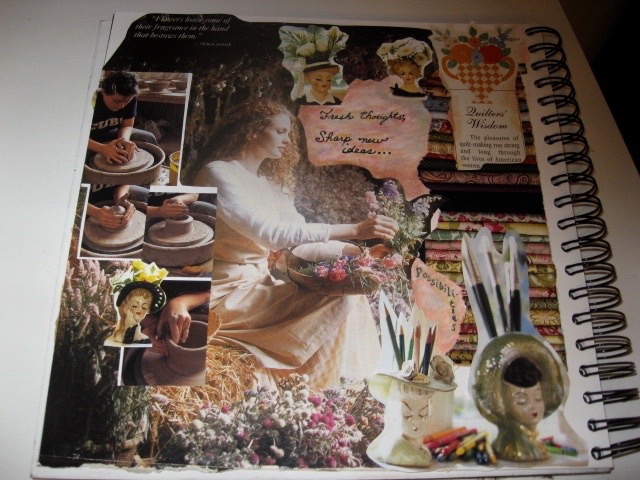
There’s a lot of imagery there that I will need to talk about in a future post, but for now let me just say it was that little girl with her handful of wild posies shyly, tentatively offering them to someone special that stirred my emotions as I thought “How like me with God!”

What do I have to offer Him but what He has already given in His vast abundance of created wonders? All I can do is pick from that abundance like a little girl in a wild and wonderful meadow and offer that back to Him.

img_1141

What would you like to offer back to God? In what form? Does His already having provided it to you make you feel small and childlike and humble?

*****


Wordsday Word: Amateur—in its Original Sense

Today our Word of the Week is …

amateur

What do you think of when you hear this word? Do you think of anything highly skilled?

Do you think of God?

img_0827
IMG_1316.JPG copy

IMG_2696.JPG copy

IMG_3144.JPG copy

IMG_2743.JPG copy

IMG_2616.JPG

Instead of giving you various dictionary definitions for our word this week, I’m going to send you to a book excerpt that explains better than I can how its meaning has changed through time, and why the book from which the exerpt comes has such a curious title: God is an Amateur.

Please click on the following link for an awesome (or awful?) look at a wonderful aspect of God that connects in so many ways to the things we’ve been considering about art and creativity and the original Creator–and us, as created in His image. Savor the first three pages (or more, if you like) of the peek inside this remarkable book, in Chapter One, “Amateurism, God, and Ourselves.” 

Then think about the question below the next photo.

IMG_2713.JPG

What endeavor do you do just for the sheer love and enjoyment of it?

SCAN0019.JPG copy


Color Feasts, Filters that Flatten their Flavor, & Five Things To Do About them

Trying to beat the plummeting temps that take me by surprise most Septembers, I start my “to-do’s” for bringing the outside inside. I trim back the leggy, and dig up the tender that won’t survive the frost.

Almost instantly I find myself reveling in a celebration of color, and rejoicing that its Maker didn’t stop at monochrome when He created light!

Coleus in Black and White
Coleus in Color
Coleus in Color
Polka-dot Plant in Black and White
Polka-dot Plant in Color

It’s true that patterns of dark and light alone in these plants beam beauty—but what a feast of fun their colors offer!

It’s also true what the last post said about how color can distract—so true that color-blind people can readily detect some things the rest of us can’t. But how grateful I am that I can still feast my eyes on such glory! I can always use a filter if I want to discern values in things like patchwork fabrics.

Each day offers us a moveable banquet of color—and I don’t mean just literally. Life is full of a spectacular spectrum that the heart and soul of even a blind person can savor.

But we sometimes erect inner filters that obscure the color of life, dull its beauty, deaden its  joy. And these inner filters don’t help anybody see anything more clearly! Quite the contrary:

Fear blocks life’s color better than my quilter’s filter “uncolors” my fabrics.

Uncertainty fogs vibrancy to gray.

Unresolved anger’s heat waves distort our view..

And the blues can cast cold shadows on everything.

So how can we fling the filters? Here are five little tools that have helped me decidedly:

The gratitude attitude-adjuster

The worry jar

The worst-case scenario activator

The “DIB” list

And “hard eucharisteo”

The gratitude attitude-adjuster: Years ago, when my life had hit its lowest pit, I heard this gem of advice from a woman who had risen out of her own pit amazingly: “If you want to change your attitude, start with gratitude!” I’ve heard many variations on it since–for good reason: Because it’s true! Because it works! Oh, maybe not instantaneously. But if I keep naming things I’m thankful for and cultivating gratitude, the view almost always gradually clears and brightens, and life starts getting back its color.

Sometime decades ago, I started journaling five thanksgivings daily. It proved a highly effective pit-preventive soul vitamin!

The worry jar: That “pit” period gave me plenty of worries. Legitimate ones. But another friend’s worry-jar tactic kept me from fretting myself sick. Here’s how it works: A worry starts jagging at your soul. You write it on a slip of paper and plunk it in the jar. You leave it there—for some pre-determined period of time (say, six months). When that time arrives, you draw out each slip and see how many feared outcomes materialized.

This works best if, when putting paper in jar, you put the worry in God’s strong hands. From others’ examples I learned, when overwhelmed with a situation, to mentally gather it into my hands, hold it up to God, and ask Him to take it, and undertake what I could not.

After six months, how many of my relinquished worries had come to life?  Exactly none!

The worst-case scenario activator: But what if one or two had? Sometimes it’s good to imagine out the dreaded event. Mentally walking mine out with God, I ended up concluding that my present angst probably harmed me more than my imagined future disaster would!

The “DIB” list: (From Harriet Braiker’s Getting Up When You’re Feeling Down) You list things you do when you’re feeling “up.” Then when sinking low, pick one of these “depression inhibiting behaviors”—and do it!  The mind associates it with a happy mood, and the emotions often follow toward happier feelings!

Finally… “Hard Eucharisteo”: Ann Voskamp followers will recognize this phrase. By it she means giving thanks for something you don’t like, and don’t feel thankful for—which is what makes it hard, but it acts something like the DIB’s, steering your feelings toward gratitude and upward.

*

It’s a beautiful creation out there today. May we all revel in it, unfiltered!


Wordsday Word: Artless—Pondering Artless Living, Part 1: Light and Dark

What would artless life be like?

art-less 1 : lacking art, knowledge, or skill : UNCULTURED <an ~ brute>   2 : made without skill : CRUDE…

There are other definitions, but these give the meanings I have in mind today.

The opposite of this ARTLESS, I would say, is ARTISTIC, and the opposite of such ARTLESSNESS is ARTISTRY

How important is such artistry in our world? Consider these definitions of ART:

art 1 : skill acquired by experience, study, or observation… 3 : an occupation requiring knowledge or skill <the ~ of organ building> 4 : the conscious use of skill and creative imagination, esp. in the production of aesthetic objects; also : works so produced 

It’s easy to think of art as a frill, an add-on, something we may incorporate into our lives only if we get the leisure after taking care of all the “important” things; otherwise we’ll waste time that “should” be better spent. Sometimes I do that. Unfortunately.

But I am thinking this morning of God as Artist, especially relative to how exactly opposite He and His creation are to the two definitions of artless above. I am considering the magnificent and intricate artistry of all aspects of His creation.

Without artistry, what would our world be? What would the sunrise look like? Would there even be a sunrise?

When I think about it, I realize that God began with art. Beauty and order.

First thing He created was light. First thing He did with it was make definition between it and darkness, even before arranging any sun, moon, and stars in a solar system. And artistry is very much about light and dark. Color is not necessary, but that two-fold element is.

IMG_0340.JPG

IMG_0340.JPG

Ever hear artists talk about light? About making the best use of lights and darks in a painting or photograph? About getting the right light to paint a scene? About parking themselves in a certain spot awaiting the precise moment when the light is just right, then grabbing that moment and painting with gusto, trying to capture its impact?—perhaps daily, doing work in segments, till the painting is completed… “in just the right light”?

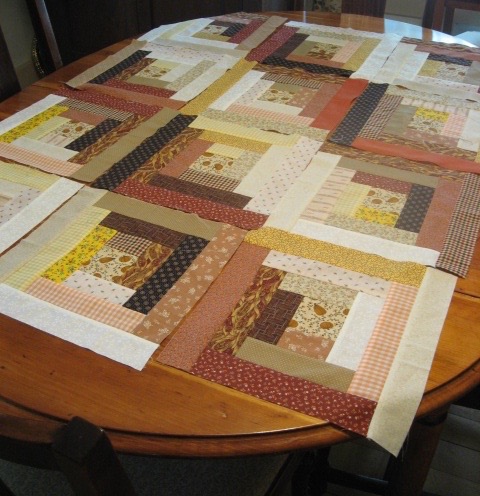
The principle extends beyond the fine arts, to the crafts and beyond. Right now, as I finish up the patchwork that’s going to be an autumn tablecloth for the coming weekend, the way I line up the blocks according to lights and darks makes or breaks the visual impact of the finished cloth.

img_1062 img_1062-1

Indeed, the blocks themselves are built on patterns of light and darkness, not always so easy to discern. Some colors fool you, if you don’t use a filter like I used when first piecing the individual blocks, and your final product may come out all wonky and less than artistic.

As it is, I did get fooled. Behold the nearest quilt block above. See how its top strip’s darkness impedes the flow of light along the quilt’s main diagonal? Follow the light fabric road away from you and you’ll notice another strip like that, cutting across it. Compare the colored photo and you’ll see what hue fooled me: Yellow. Psychologically, we think it’s light and bright but it isn’t always. Red fools us in the opposite direction: often impressing us as much darker than it is.

This is why an award-winning quilt-maker I once heard speak at a quilters’ gathering was often complimented for her excellent “color sense,” and had her creations displayed in places like the White House: She was, in fact, color-blind!

Surely there’s a parable in all this, but I have no room for one here. We’re focusing here on artistry and artlessness/art-less-ness, and how even the principles of light and darkness can help open our eyes to God’s creative artistry.

In future posts, let’s consider and explore the principles of form and color—in art and artful life. Meanwhile, let’s notice, and emulate, God’s artistry, and not live art-less. Let’s ask Him for more discernment to detect and differentiate the lights and shadows.

As for that patchwork layout above, it’s passable “for just a scrap quilt,” but after considering the artless and  the artistic, I think I want to do some rearranging before I sew all the blocks together—maybe even some ripping out and redoing…

*****


On Creativity: More Thoughts on an Intriguing Question

Picking up from the last, unfinished post…

So, my own personal answer that popped up reflexively inside my head when I heard the question “What is the most creative thing you’ve ever done?” It was…


IMG_3278.JPG copy copy IMG_3825.JPG IMG_7731.JPG IMG_2904.JPG IMG_4886.JPG img_0818 IMG_6709.JPG IMG_9647.JPGIMG_6317.JPGIMG_8105.JPG IMG_9033.JPGIMG_9570.JPGIMG_8516.JPGIMG_8894.JPG


“Having a baby!”

But immediately I wondered why, because I hadn’t really created anything then at all. I’d even heard of women who didn’t know they were pregnant until they started giving birth. And you don’t have much choice once that starts happening, do you? It. just. happens.

Yet, as I typed all the dictionary entries below into the last post, it finally struck me. Look at the definitions for “create,” and “creator”:

creativity : the quality of being creative : the ability to create

creative : marked by the ability to create : given to creating : having the quality of something created rather than imitated : IMAGINATIVE

create 1 : to bring into existence <God created the heaven and the earth -Genesis 1:1 (AV)> … 4 a : to produce through imaginative skill : DESIGN

creator : one that creates, usu by bringing something new or original into being: esp, cap : GOD*

The designer/creator (Creator) of that baby I gave birth to surely wasn’t me. However, in no other event in my life was I so closely, so intimately involved in God’s actual bringing forth “into existence,” “into being” something new and original—and in this case living and human to boot! Now the more I think about that, the more staggered I get! What a breathtaking privilege!

There is, indeed, something so awe-evoking about birth itself, even of baby goats or sheep or cows, that I’ve heard more than one long-time veterinarian say, no matter how often they’ve witnessed it, it still awes them the next time they see it happen.

I’m thinking of how witnessing the birth of any of our goats (here on the funny farm) always  affected me.   It stunned me into silence, and a deep sense of not only awe but… well, I believe, humility. Sensing the enormity of, and the infinite divine involvement in, the creation process for anything living made me step back, feeling comparatively very, very small.

Now, as I write, I also think personally that either experiencing or witnessing birth can give one a greater appreciation for the creative process that brings forth any new thing into existence–and a greater humility about one’s own part in that process as well—plus, if we are perceptive and humble enough, a greater awed gratitude that we are so privileged as to be partners with God in that process, the creative laborers through whom He works.

Right now I’m remembering a writers’ conference I attended where the fifty-something keynote speaker began her talk by announcing, “I’m pregnant!” Of course this caught everyone’s attention, but she then went on to explain how she was pregnant with an idea for her next novel, and to liken the whole process of authoring a book to gestation and giving birth.

It’s an apt and useful analogy. When we get inspired to create any new thing:—a story, a painting or sculpture, a new weaving or clothing design—why and how does the mysterious process happen? Surely this is a gift from the Creator, allowing us to echo and reflect Him, even though still dependent on His provision of the abilities and even the materials for it all to happen.

I hope I remain so impressed about this that I can’t pick up a pen or computer keyboard,  or a handful of collage materials or bits of fabric or yarn, without getting a little breathless at the privilege God is giving me, and the grace by which He is enabling me to follow through on a… “creation.” And I pray that He gives any creative women reading this the same flood of awe.

***

As a footnote, several scripture passages that point out God’s gifting of and working through human individuals rush into my mind. Additionally, last evening, as Husband and I read the final chapter of 1 Chronicles together after dinner, I saw a wonderful example of how not only the ability to echo His creativity, but also the materials with which to do it, come ultimately from Him alone. To read any of the passages below, just hover your cursor over the reference, and if you want to see more of its context, click on the reference:

Exodus 35:30-33, 34-35, 25-26; 36:1-2,8 [Throughout this and surrounding chapters the phrase “gifted artisans” occurs repeatedly.]

1 Chronicles 29:9-12,13-15,16-18

Colossians 1:24-25, 29

Philippians 2:12-13 {Note: the Greek word translated “work” in verse 12 and the one translated “works” in verse 13 are not the same word at all. I hope to write a post some time about this awesome synergy.]

Ecclesiastes 3:10-13; 5:19

*****


*Merriam Webster’s  Collegiate Dictionary, Eleventh Edition