Multiplying the Treasure of Prayer (Part Three: What Else to Start With)

They walk together into prayer, hand in hand, or at least they ought to: gratitude and something else, the living partner important not to leave behind.

I see it in all the last post‘s Psalm references. Do you see it? (Ps 75:1; 92:1; 100:4; 105:1-3; 106:1; 107:1; 118:1; and 136:1-3)

I see it William Law‘s recommendation for morning prayers: “When you begin… use… expressions of the attributes of God [that] make you most sensible of [His] greatness and power.”

I see it in the name for tradition’s early morning time of prayer: “Lauds.”

And yesterday, thinking about all this, I saw it again, blog-hopping—in this quote from C.S. Lewis:

Gratitude exclaims, very properly, “How good of God to give me this.” Adoration says, “What must be the quality of that Being whose far-off and momentary coruscations are like this!” One’s mind runs back up the sunbeam to the sun…

[Of course, I had to look up “coruscations.” I think “glittering flashes” expresses Lewis’s intended picture. He goes on…]

…If I could always be what I aim at being, no pleasure would be too ordinary or too usual for such reception; from the first taste of the air when I look out of the window… down to one’s soft slippers at bedtime (pp.89-90).

and from the blogger who quoted him in Crumbs from His Table:

“Gratitude is good, commanded, right. This idea of turning all into adoration of the good God who creates and sustains it, though,…this captures my imagination and challenges me to keep growing.” [Read more of the good thoughts she expresses here.]

Thanksgiving walks with praise, gratitude with adoration, through the door to rich communion with God in prayer.

So how do we cultivate this?

Law gives one helpful instruction above—and also lists expressions of who God is that evidently helped open up his adoration when he prefaced prayer with them, such as…

Savior of the world,

God of God

Light of light,

Thou that hast destroyed the power of the devil,

O Lord God most holy,

O Lord God most mighty,

O holy and merciful Savior,

Fountain of Mercy,

Thou Who was scourged at a pillar…

Thou Who didst cleanse the lepers [or, fill in the blank with any appropriate example from scripture]…

and the like. Thus Law invites us to “…meet every rising sun with such sentiments of God’s goodness, as if you had seen it… new created on your account: and under the sense of so great a blessing, let your joyful heart praise and magnify so good and glorious a Creator.”

I keep a little heart-shaped basket filled with such names of God and scriptures telling of His love and holiness and power and other attributes, to draw out one after one at times, like when my heart is distracted or dull toward God.

What a way to begin each morning! Reveling in all He is, drawing near, giving thanks and adoration. What better way to set the pace for any day?


Multiplying the Treasure of Prayer (Part Two: The Best Beginning?)

Whether I “rise at midnight” (Ps 119:62), beckoned by the bathroom, and stay up long enough to pray an interval, or “awaken the dawn” (Ps 57:8;108:2), or if I oversleep and stagger from the bedroom amazed how I slept so long (for once), I have come to the conclusion that there is a best beginning, a superior way to open both the day and its prayer progression.

It’s really plain and simple. Right there in the text: “Enter His gates with thanksgiving and His courts with praise” (Ps 100:4).

It’s there in many psalms’ first verses: Ps 75:1; 92:1; 105:1; 106:1; 107:1; 118:1; and 136:1-3.

It’s mentioned for the first rising of the new twenty-four hour period: “At midnight I will rise and give thanks to You.” (You can’t get earlier than midnight!)

And it’s the vital missing ingredient in Romans 1:21, where the decline of man, or anyman, or anywoman, gets its start: “For though they knew God, they neither honored Him as God, nor gave thanks to Him…” From there proceeds the darkening of the heart—and how dreadful that is!

Me? I’m back to keeping my “gratitudes list”—five new, never-before-mentioned gratitudes each day—starting my mornings by journaling them as I express their thanksgiving to God—yes, even at midnight, if that’s when I first rise. (Of course, that early, they’re things of the day before or the night just spent, or general gratitudes for all God is and what He does.)

Starting this way not only sets the tone aright for the day ahead, but acknowledges the grace and mercy and benevolence of God before I ever badger Him with requests. This only makes good practical sense, for how can I expect good gifts from Someone I don’t recognize and acknowledge as the Giver of good gifts? And not thanking one so gracious is wholly ungracious!

Yes, it’s right and proper to thank Him before we go to bed, but it’s only right to enter His gates next morning in the same spirit of gratefulness.

And so I plan to do.

And here’s a special gift that can help us do it. Another link to Ann Voskamp’s site, and a really cute little mini-book you can download and print out (at the end of her post for today), plus a link included right there with it, to a slick video instruction in how to fold, snip, and (a second time) fold it together into its delightful little form. Have fun with this and enjoy your blessed gratitudes!

Entering His Rest

It’s barely a sheep tale. And it’s about a crucial issue. So I’m posting it as a blog post (just previous to this one) for a while. But even now you can also find it in the Pasture Parables Pages at this link: He Makes Me Lie Down.

However, either before or after you read the parable, I strongly urge you to go to this link and read Ann VosKamp’s whole article, How to Live in This Economy, and the comments that follow it on the High Calling Website (linked in her post). She speaks it so beautifully, our need for sabbath rest, and so many other people’s comments are so filled with wisdom, you really need to read them also in conjuction with “He Makes Me Lie Down.”

May you know the joy and beauty of His sabbath rest.

He Makes Me Lie Down


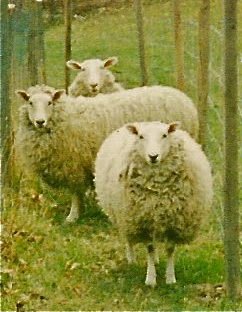
The sheep lie peaceful in green pasture, legs tucked under, recline and ruminate—do nothing else but gaze around (if even that), and feel the breezes on their faces.

What if we did that? 

What would people think? 

It looks the epitome of laziness.  And yet… And yet…

Psalm 23, the Psalm about the LORD as “my shepherd,” says, “He makes me lie down in green pastures.” Why? Is His main concern that His sheep catch up needed rest, or just relax, because of their stressful, rat-race life?  Or is there more to this?

….

It was a spot where “much grass” grew on Galilee Sea’s far side, around the time of Passover. The flock was large (over 5,000), so intent on following the Shepherd that almost none had brought food.

And Jesus posed a question, to one of His disciples:

Where shall we get bread for them?

No idle remark, this, nor bread’s mention simply literal…

After collecting a tiny amount of barley bread, He made them lie down in green pasture. (The Greek word in John 6:10 usually translated “sit” actually means recline. In the prevailing Roman culture people reclined to dine.)

They broke the bread, and it multiplied as they gave it to the people, there on Galilee’s hillside. The people partook and were satisfied, with abundance left over.

Then after this miraculous feeding, He told them the most vital bread they needed:

“The bread come down from heaven.” 

Himself.

I am the bread of life.”

Sometime later, while His smaller flock “reclined at table,” He took bread again and broke it, saying, “This is my body, given for you. Take, and eat.”

The broken Word become the food to satisfy with Eternal life.

But why did He make His sheep lie down?

A sheep needs to ruminate.  The sheep that doesn’t, remains in want. Without the ruminating, its body makes no use of what it’s taken in. It just accumulates there, useless, and that sheep, though full of food, is dying slow death from malnutrition.  For sheep, like cows and goats, have more than one stomach compartment.  The first receives food as a storage tank—a personal food bank, from which deposits must be withdrawn for use.

And sheep need to lie down to ruminate. After racing or grazing, it’s time to stop, recline, withdraw nourishment from the inner pantry, and chew.  Chew it up, swallow it back down, to send out nourishment, to strengthen, and fuel for action.

We too need to stop and rest and ruminate, so that we’ll not just take in spiritual nourishment, but also gain the good of it.

Our sheep ruminate. They settle down, tuck legs under… quite on their own.  But I have read of shepherds who must make their sheep recline, or the meandering flock will just keep grabbing and grazing, and never get around to ruminating.  And die. From the inside out.

To do: Find time to get still and ruminate on the bread of life. Make time. It’s essential.

Disappearing Treasure

I’ve found a treasure!

And what a wonder—obscured and disappearing!

I stumble upon it, through a series of meandering steps…

I take the book down from the shelf—

a collection: the “essence” of four historic volumes. I open it, start to read the “essence” of the first.

Something doesn’t sit right.

They don’t come off real somehow: these summary sentences and substituted words and chopped-short chapters, and (especially) the anachronisms—like an early 1700’s writer assessing modern elementary schools, and even television!

So I go to the blessed internet, and find the original manuscript, the nearly three hundred (large) pages that the “essence” book boils down dry to essentially fifty (small) pagefuls of print!

And there I happen upon it: The Great Treasure that goes missing! The “essence” book completely omits it. And it’s nearly vanished from modern Christendom—this “treasure” I’m convinced we could definitely use!……

Buried in the original text, I discover again the same diamond cache I lately unearthed elsewhere: The hours! The sweet hour­s of prayer (plural) that once guided the ordinary Christian’s day!

I discovered it first evolving in my own days, developing strangely, quite spiritually-automatic as I aspired to draw ever nearer to God. I gained a label to pin on it only after researching Medieval days.

I bumped into it again after clicking a link to Phyllis Tickle’s books, The Divine Hours— reading her introduction: clear evidence that set prayer hours preceded Christian monasticism by centuries. (“Look inside” Tickle’s book at “Introduction to this Manual”)

And my own earth-life showed me, painfully, my need for right-spaced spiritual refueling through my day (“just coincidentally” spaced at the same time lengths as the ancient hours).

Now here “The Hours” appear again. In this book by William Law.

In the original, that is. But not  in the modernized summary version. And that tells on us as a culture—especially when we read the modern compiler’s reason for leaving out whole sections: “I have eliminated… thoughts… I believe… irrelevant and less helpful to today’s reader.”

I find nothing in his whole summary even referring to set times at which to draw aside to God. Evidently he judged prayer “Hours” irrelevant, not helpful today.

How at odds with my recent experience! The “hours” practice is changing my life, each day of it! And how I wish I’d incorporated these rhythms decades ago! How I wish I’d known!

My past feels robbed. 

In my present, however, that which frenetic drivenness and distraction have robbed, God is restoring. In part, by “the Hours.” And how I thank Him!

It’s not happening overnight. It hasn’t happened fully yet. It’s developing. And the more I get it implemented in my days, the more richly I am blessed and blessed.